Floyd's Triangle
PythonHardalgorithmsconditionsmath
Instructions
Floyd's triangle is a right-angled triangular array of natural numbers. It's defined by filling the rows of the triangle with consecutive numbers, starting with a 1 in the top left corner:
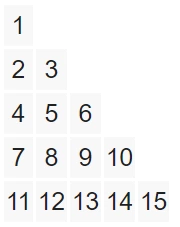
Write a function that takes an integer n and returns Floyd's triangle's rows as a list of lists. Your function should return one of two possibilities:
- If a value is passed to
n_row, return the firstnrows. - If a value is passed to
up_to, return all rows up to, and including, the row that containsn.
Expect an argument to be passed to one parameter or the other, but not both.
Examples
floyd(up_to = 5) ➞ [[1], [2, 3], [4, 5, 6]]
# The third row contains a 5.

floyd(n_row = 5) ➞[[1], [2, 3], [4, 5, 6], [7, 8, 9, 10], [11, 12, 13, 14, 15]]
# Returns the first five rows.

floyd(up_to = 10) ➞ [[1], [2, 3], [4, 5, 6], [7, 8, 9, 10]]

floyd(n_row = 1) ➞[[1]]
Notes
Hint: You can define n_row from up_to using the triangular number sequence. That is, n_row should be x in the equation (x*(x+1))/2 = up_to rounded up. Then, you only need to write a function for n_row.
python3
Loading editor…
⌘ ↵ to run
Walks through the solution with reasoning and edge cases.