Colour Harmony
PythonHardarrayslanguage_fundamentals
Instructions
In colour theory, colour harmony refers to an aesthetically pleasing combination of colours. The standard colour wheel shows the 12 primary, secondary and tertiary colours. Starting with red, and moving clockwise, the colours are:
colours = ["red", "red-orange", "orange", "yellow-orange", "yellow", "yellow-green", "green", "blue-green", "blue", "blue-violet", "violet", "red-violet"]
With an initial colour (called the anchor), you can find combinations of harmonious colours. The combination types are shown below, for an anchor colour of green:
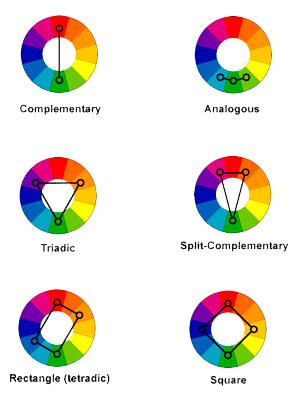
Given an anchor colour and a combination type, write a function that returns a set containing all colours within the combination.
Examples
colour_harmony("green", "triadic") ➞ { "green", "violet", "orange" }

colour_harmony("blue-green", "complementary") ➞ { "blue-green", "red-orange" }

colour_harmony("orange", "analogous") ➞ { "yellow-orange", "red-orange", "orange" }
Notes
- Create the combinations given their relative positions from the anchor colour. For example, the rectangle combination starts with the colours two positions clockwise and four positions anti-clockwise from the anchor (and not the other way around). With the split-complemetary combination, you take the colours five positions both clockwise and anti-clockwise from the anchor. For the analogous combination, you include the colours directly on either side of the anchor.
- Include the anchor colour in the final set.
python3
Loading editor…
⌘ ↵ to run
Walks through the solution with reasoning and edge cases.