Maya Number System
PythonHardmathformattingnumbers
Instructions
Maya numeral system was vigesimal (base 20) and positional: units, tens, hundreds (and so on) were read as descendant progressive powers of 20, instead of 10 like we do with our decimal system. Some examples:
- 39 => (1 x 20¹) + (19 x 20º)
- 815 => (2 x 20²) + (0 x 20¹) + (15 x 20º)
- 16125 => (2 x 20³) + (0 x 20²) + (6 x 20¹) + (5 x 20º)
Every digit (as to say the number to be multiplied for the power of 20) was symbolized with a combination of pebbles (dots), woodsticks (lines) and shells (used for the number 0) following a base5 system. See the table below:
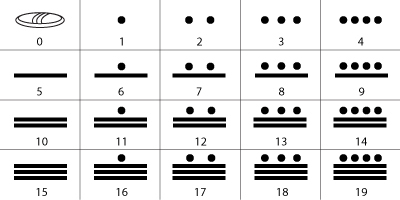
You must implement a function that, given a non-negative integer, returns a list of strings, with each string representing the symbolized single digit.
Symbols to use are "@" for shells, "-" for lines and "o" for dots. Dots have to be placed before the lines.
Examples
# Be careful, spaces between symbols are placed only for better readability!
# Don't use spaces in returned strings.

maya_number(39) ➞ ["o", "o o o o - - -"]

maya_number(815) ➞ ["o o", "@", "- - -"]

maya_number(16125) ➞ ["o o", "@", "o -", "-"]
Notes
- All given integers are valid, no exceptions to handle.
python3
Loading editor…
⌘ ↵ to run
Walks through the solution with reasoning and edge cases.