The Happy Function
PythonHardalgorithmsnumbersloopsrecursion
Instructions
In this challenge, you have to implement an algorithm to establish if a given positive integer num is a Happy number, and how many steps of the algorithm are needed to establish it.
You have to repeatedly transform the given num into the sum of its squared digits:
- If after the transformation the new number is equal to
1,numis a Happy number and the algorithm stops. - If after the transformation, the new number is not equal to
1, you have to transform it again.
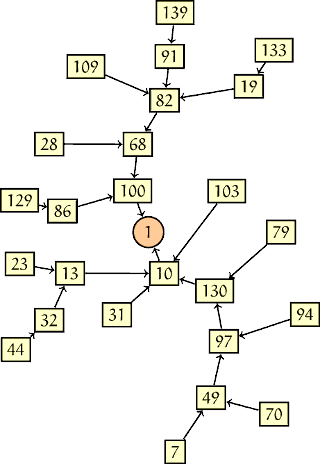
If a number can't be reduced to 1, sooner or later the algorithm will enter into an infinitely repeating loop:
... 20, 4, 16, 37, 58, 89, 145, 42, 20, 4 ...
Given a positive integer num, implement a function that returns:
- If
numis a Happy number, the string"HAPPY x"with the "x" being the number of steps necessary to reducenumto 1. - If
numis not a Happy number, the string"SAD x"with the "x" being the number of steps necessary to enter into the infinite loop reaching so any number in the series4, 16, 37, 58, 89, 145, 42, 20, plus the number of steps necessary to obtain again that number.
Look at the examples below for a better visualization.
Examples
happy_algorithm(139) ➞ "HAPPY 5"

# Step 1: Transform 139
# 1² + 3² + 9² = 1 + 9 + 81 = 91

# Step 2: Transform 91
# 9² + 1² = 81 + 1 = 82

# Step 3: Transform 82
# 8² + 2² = 64 + 4 = 68

# Step 4: Transform 68
# 6² + 8² = 36 + 64 = 100

# Step 5: Transform 100
# 1² + 0² + 0² = 1 + 0 + 0 = 1

# The algorithm stops at step 5: 139 is a Happy number

happy_algorithm(67) ➞ "SAD 10"

# Step 1: Transform 67
# 6² + 7² = 36 + 49 = 85

# Step 2: Transform 85
# 8² + 5² = 64 + 25 = 89
# It entered into the infinite loop...
# ...but we have to demonstrate that is a loop!

# Step 3: Transform 89
# 8² + 9² = 64 + 81 = 145

# Step 4: Transform 145: result is 42
# Step 5: Transform 42: result is 20
# Step 6: Transform 20: result is 4
# Step 7: Transform 4: result is 16
# Step 8: Transform 16: result is 37
# Step 9: Transform 37: result is 58
# Step 10: Transform 58: result is 89

# 89 was the result of step 2: it's a loop
# The algorithm stops at step 10: 67 is not a Happy number

happy_algorithm(1) ➞ "HAPPY 1"

# Step 1: Transform 1
# 1² = 1

# The algorithm stops at step 1: 1 is a Happy number

happy_algorithm(89) ➞ "SAD 8"

# Step 1: Transform 89: result is 145
# Step 2: Transform 145: result is 42
# Step 3: Transform 42: result is 20
# Step 4: Transform 20: result is 4
# Step 5: Transform 4: result is 16
# Step 6: Transform 16: result is 37
# Step 7: Transform 37: result is 58
# Step 8: Transform 58: result is 89

# 89 was the original number: it's a loop
# The algorithm stops at step 8: 89 is not a Happy number
Notes
- The transformation of a single-digit number is, trivially, the square of the digit (see example #3).
- If the given number is
1, a step is needed to establish if it's Happy (see example #3). - To establish if a number is not happy, you have to find the number of steps necessary to obtain again a number already found (it can be a number obtained through a transformation as in example #2 or the same given number as in example #4).
- You can expect only positive integers as input, without exceptions to handle.
python3
Loading editor…
⌘ ↵ to run
Walks through the solution with reasoning and edge cases.